The Unconventional Path
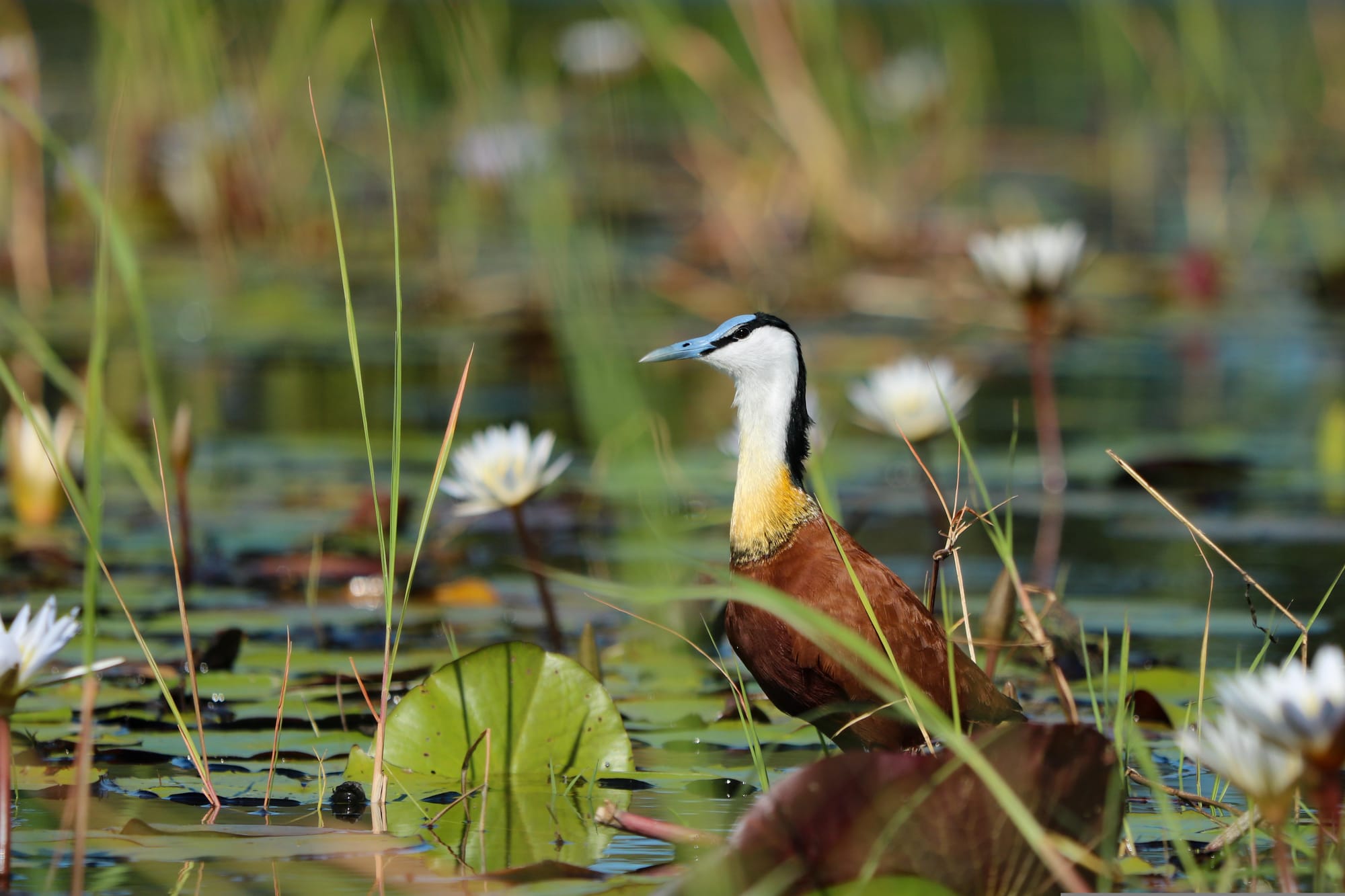
A letter from the Lily Trotter
Every time I sit down to research yet another species this world has to offer, I find myself wondering: where is nature taking me this time?
So this time, I thought, let's look to the sky.
I settled on the African Jacana, also called the Lily Trotter, expecting an extraordinary story about fatherhood. After all, this is the bird where Dad builds the nest, incubates the eggs, carries the chicks beneath his wings, and spends the first few weeks looking after them.
A story about an involved father, I thought.
Except, the more I learned about the Jacana, the more I realised that fatherhood was only the beginning.
The female is larger than the male. She holds a territory that can contain several males. She mates with multiple partners. The males compete for her attention, build the nests, incubate the eggs, and raise the chicks. And the chicks themselves can communicate with one another from inside their eggs before they hatch.
At some point, somewhere between the floating nests, territorial battles, and chicks being carried around like tiny passengers, I had to admit:
This bird is really doing things its own way.
But before we get to all of that, let's start with those feet.
The African Jacana lives in shallow freshwater wetlands, where floating vegetation is an unlikely highway. Water lilies, reeds, and other aquatic plants provide both food and somewhere to move about. And the Jacana has the perfect equipment for the job: extraordinarily long toes that spread its weight across the vegetation, allowing it to walk over floating leaves without immediately disappearing into the water.
It is one of those things that seems almost comical until you understand why it exists.
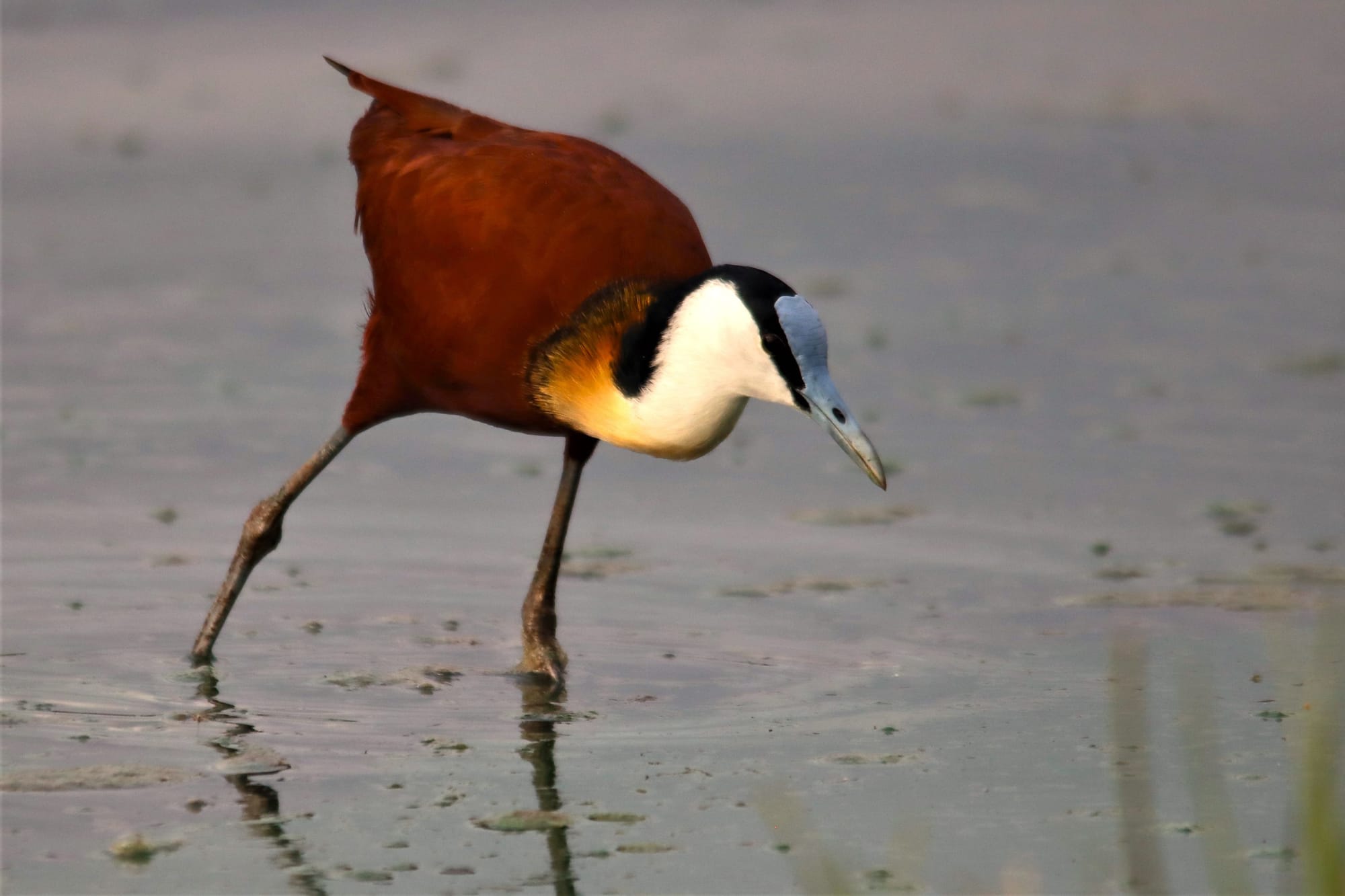
From a distance, the bird appears to be walking on water.
Hence the nickname 'Lily Trotter'. And really, what else would you call a bird that spends its days high-stepping across lily pads? Those ridiculous feet make perfect sense for the world in which the Jacana lives.
And that turns out to be a recurring theme with this bird.
Take the nest, for example.
If you are imagining a carefully woven little nest tucked safely into a tree, forget it. The African Jacana builds its nest on floating vegetation over still water, made from a heap of aquatic plant stems that can be flimsy, damp, and surprisingly exposed.
The male does the building. And he may build several platforms before settling on one. Then come the eggs.
And they are rather beautiful.
Usually four are laid, one day apart, and they are a deep tan colour, covered in dark chocolate-coloured markings that look almost like someone has dribbled paint across the shell. Each egg has its own abstract pattern, and their pear-shaped shells have a remarkably polished, glossy appearance. There is even a practical reason for all that shine: the glossy surface may help the eggs blend into the glare of the water and surrounding vegetation.
Once the female has laid her clutch, she leaves the male to get on with the business of incubation.
And he has quite a job ahead of him.
Incubation lasts around 25 days, and because the nest is little more than a floating heap of vegetation sitting just above the water, keeping the eggs safe and dry is not exactly straightforward. The male can slide the eggs beneath his wings and hold them against the brood patch on his belly to keep them warm. If the water rises and the nest begins to sink, the eggs can even be pushed to a safer position.
And then there is the part that I genuinely cannot get over.
For up to two days before hatching, the chicks can call to one another from inside their eggs.
Yes. Inside the eggs!
I like to imagine a tiny Jacana version of Marco Polo happening in there.
“Are you ready yet?”
“Almost.”
“I think I'm ready.”
“Wait for me.”
Except this isn't just a cute little coincidence. Their calls appear to help synchronise when they hatch, so the chicks can essentially coordinate their arrival into the world before they have even met face to face.
And then, when they finally hatch, they are already remarkably independent. The chicks leave the nest soon after emerging, can feed themselves and, when danger appears, can dive underwater and swim away, resurfacing somewhere nearby.
So they have had their little pre-hatch conversation, coordinated the grand entrance and then, almost immediately, are ready to get on with life. This is quite the sibling bond, isn't it?
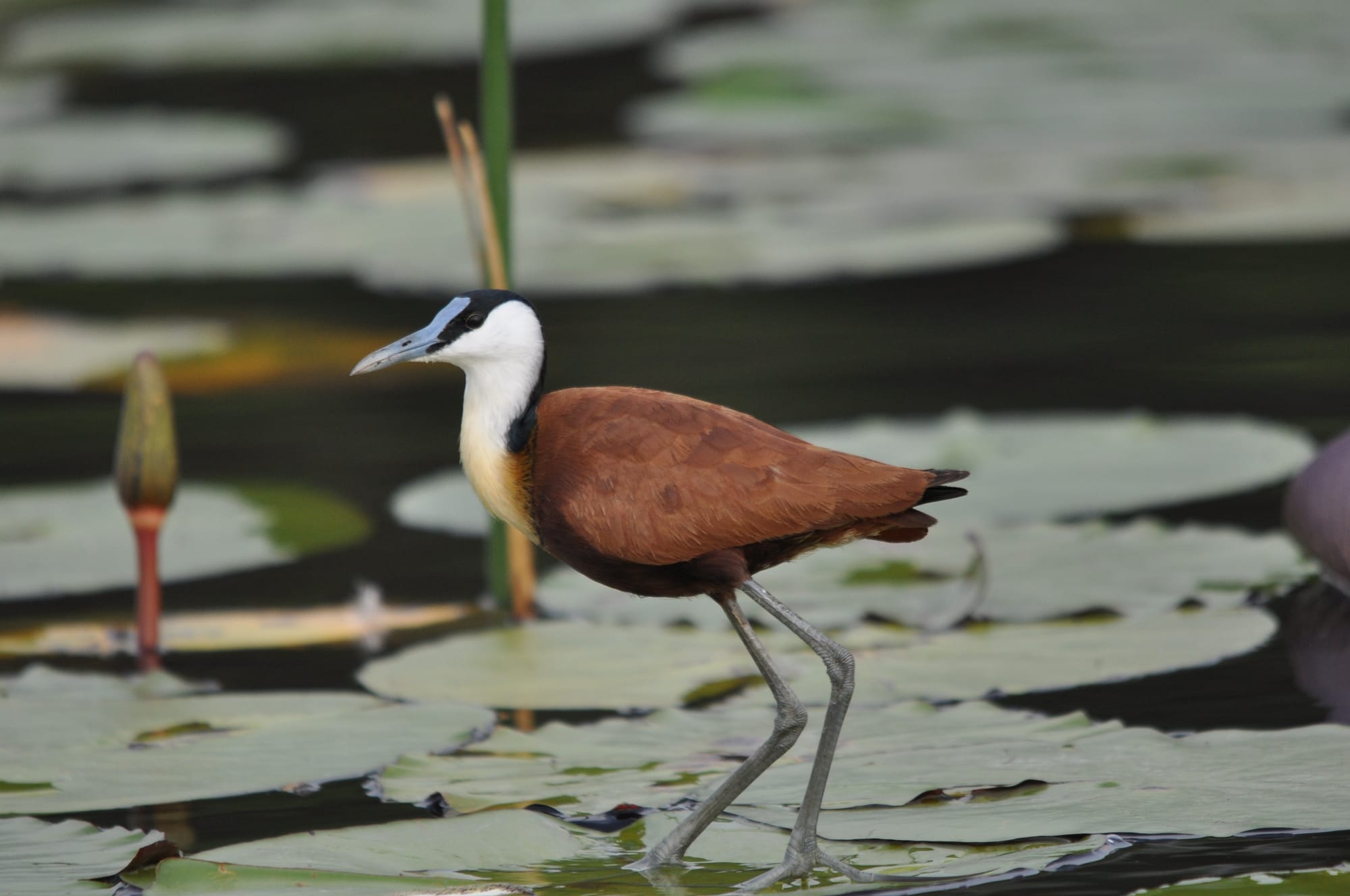
They can fly at ~40 days old, although they are not particularly graceful fliers. Those extraordinary toes that make them so wonderfully suited to walking across floating vegetation are not exactly designed for sustained aerial travel. When seasonal wetlands begin to dry up and they need to move between habitats, sometimes travelling hundreds of kilometres, they mostly make those longer journeys at night. The cooler, calmer air helps, but there is another very practical reason: a low-flying, slightly awkward bird with dangling legs is a much easier target for a daytime predator. Under the cover of darkness, the Jacana has a little more room to make its journey.
They are generally left to fend for themselves after 40 to 50 days. A male may even rear two broods in a season.
And while all this is happening, the female Jacana is not sitting beside the nest waiting for her chicks to grow up. She has moved on.
This is where the story gets particularly interesting.
The African Jacana is polyandrous, meaning females mate with multiple males during the breeding season. Her territory is considerably larger than those of the individual males and can encompass several male territories, usually one to three, but sometimes as many as seven.
Both sexes are strongly territorial. Males compete with one another for breeding territories and the attention of females, while females defend their much larger territories from other females. The males themselves are solitary nesters, with neighbouring nests usually more than 50 metres apart.
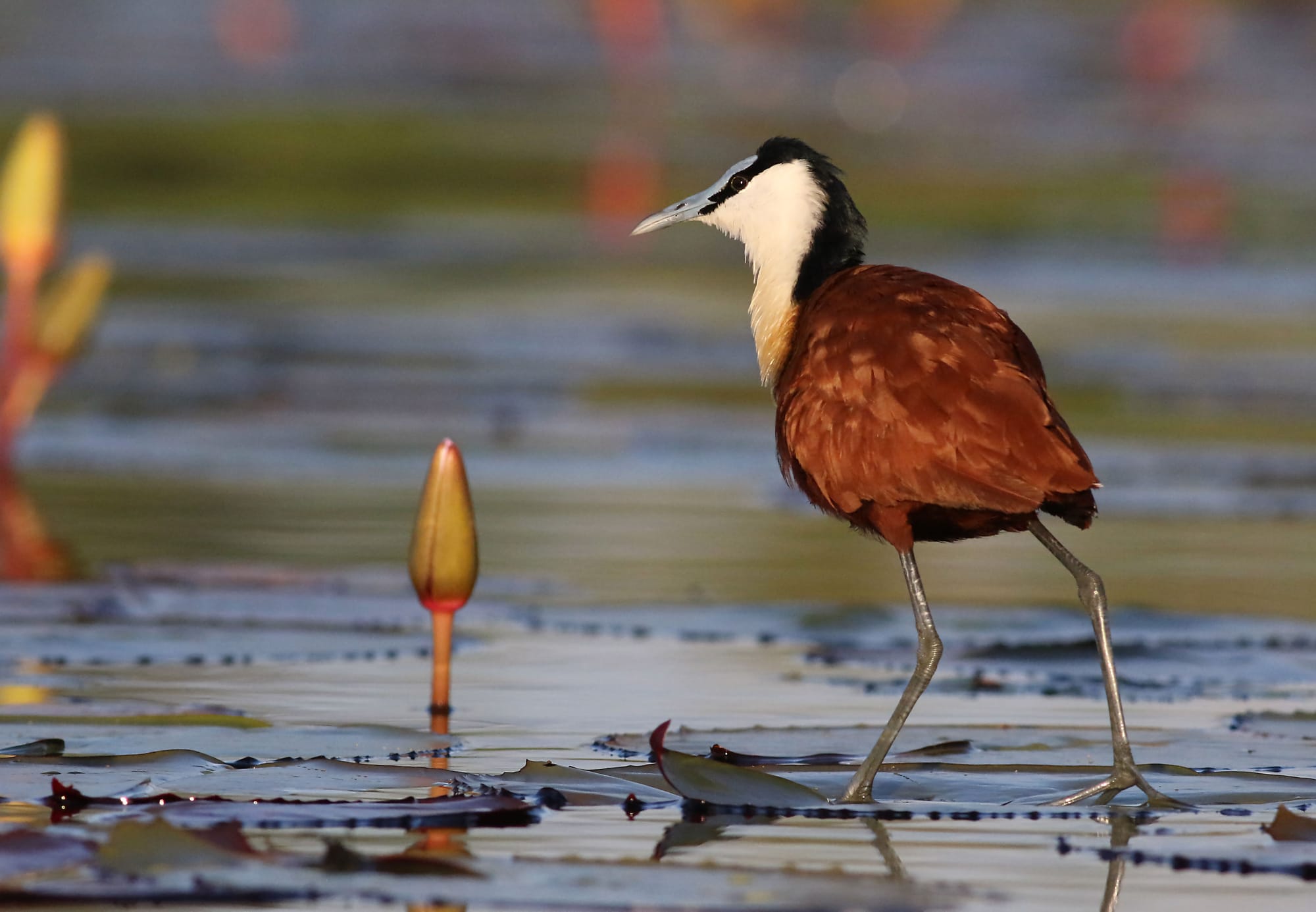
A male hoping to attract a female may call from a little platform made by pulling together nearby plant stems, sometimes hopping up and down as though putting on his best possible performance for the occasion.
And the female may mate with several males. Then she lays a clutch for one of them. And moves on to another.
Meanwhile, the male gets on with the considerably less glamorous business of incubation and childcare.
It is a remarkably unusual arrangement, but there is a reason for this.
The African Jacana lives in productive wetlands where food can be abundant, and the female can produce successive clutches while individual males are occupied incubating eggs and raising young. With each male tied up with a nest and brood for weeks at a time, parental care becomes an important limit on how quickly reproduction can continue.
So the female moves between males. One male is incubating. Another is courting. Another may soon have a clutch of his own. And the cycle continues.
It is a solution to a very particular life in a very particular habitat.
And we're not done; this bird is highly adaptable, capable of moving between wetlands, sometimes travelling long distances at night. Their dependence on floating vegetation means they follow the water and the habitat it provides. When conditions change, they can move too.
But there is one more part of this story that matters.
Because the African Jacana may be doing just fine for now, but the wetlands that make its unusual life possible are not always doing quite as well.
The African Jacana is widespread across sub-Saharan Africa, from Senegal and Mauritania in the west, across the continent to Ethiopia and Somalia, and south through the wetlands of eastern and southern Africa. It is largely absent from the driest regions and from continuous lowland forest, but wherever there is suitable shallow freshwater, floating vegetation and the right conditions, the Lily Trotter may turn up.
And yes, this is a bird from Africa.
The name African Jacana is doing a fair amount of work there.
Its scientific name is Actophilornis africanus, and it belongs to the Jacanidae family, a small family of tropical waterbirds. Taxonomically, the Jacanas sit within the order Charadriiformes, the same broad bird order that includes many familiar shorebirds and waders.
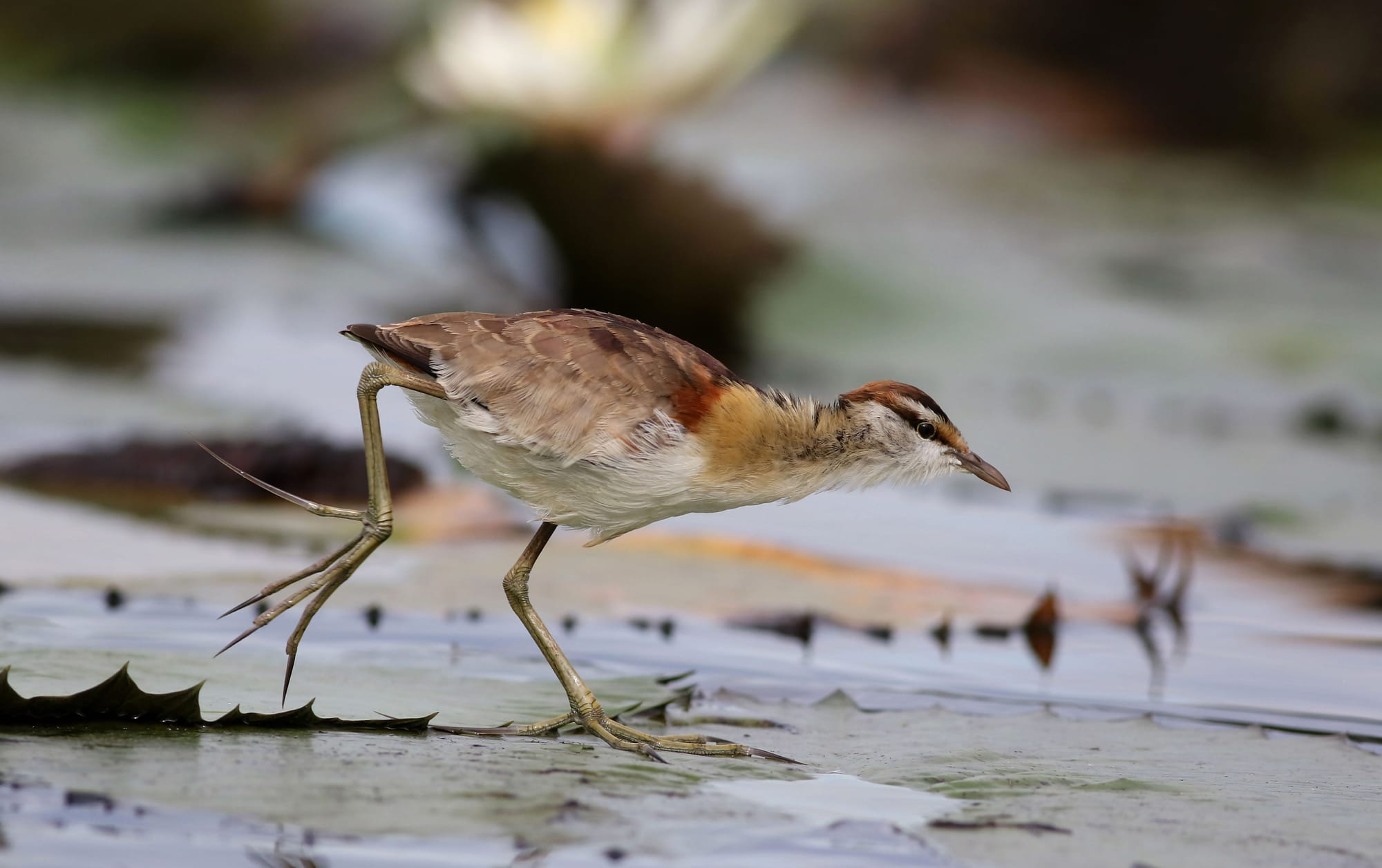
There are other Jacanas elsewhere in the world, particularly in Asia, Australia and the Americas, but Africa has two species: the African Jacana and the much smaller, more elusive Lesser Jacana. The Lesser Jacana has a scattered range across parts of sub-Saharan Africa and is generally associated with shallow, seasonal freshwater wetlands.
Our Lily Trotter, meanwhile, is currently listed as Least Concern globally. Its population is considered large, and the species remains widespread and adaptable. In other words, this is not a bird we need to imagine on the brink of disappearing tomorrow.
But that does not mean its habitat is safe.
The African Jacana is tied to freshwater wetlands such as marshes, floodplains, seasonal pans, lakeshores, slow-moving rivers and other shallow wet places where aquatic vegetation can flourish. Those wetlands are increasingly affected by cultivation and development, pollution, overgrazing and changes to natural water levels through dams and other forms of water management.
And this is where the story becomes bigger than the bird.
Because when we lose a wetland, we are not simply losing a patch of soggy ground.
We are losing an entire living system. The lilies that become highways. The insects that become breakfast. The fish and invertebrates beneath the surface. The reeds and emergent plants that provide cover. The birds that arrive when the water does. The frogs, dragonflies, mammals and countless other species whose lives intersect there. For the African Jacana, a wetland is not scenery.
It is a home, a nursery, a dining room, and a road network all rolled into one.
And perhaps that is why conserving these places matters even when a species is not yet threatened.
We do not always have to wait until the last few individuals are left before we decide that a habitat is worth protecting.
The Jacana is still out there.
Still trotting.
Still nesting on floating vegetation.
Still carrying chicks beneath its wings.
Let's make sure there are wetlands left for it to do all of that in.
So the next time you see an African Jacana stepping lightly across a pond, take a moment to watch.
Look at those ridiculous feet.
Look at the floating leaves beneath them.
Look at the father carrying his children beneath his wings.
And perhaps remember that there is more than one way to cross the water.
Sincerely,
Blue